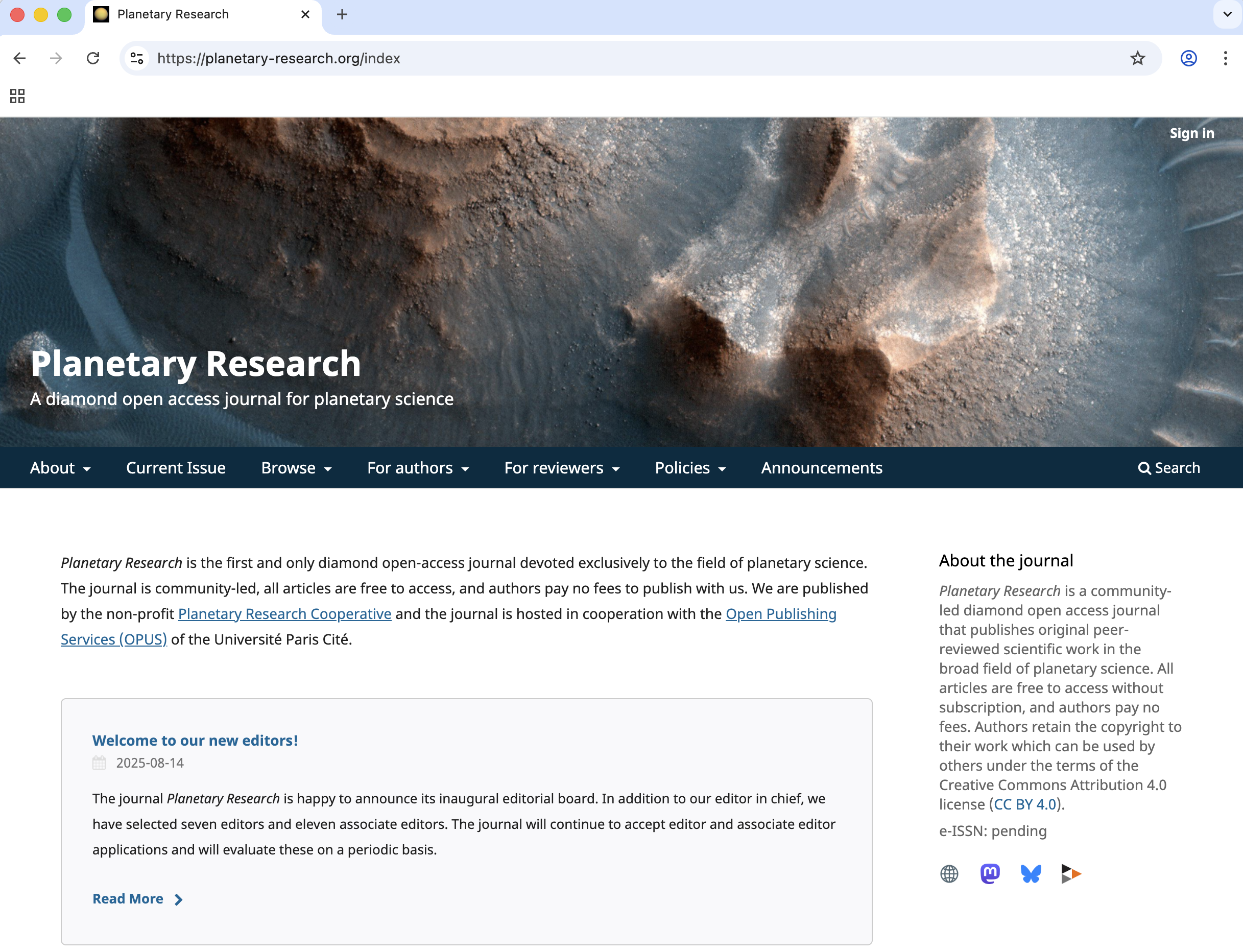
Planetary Research is the first and only diamond open-access journal that is devoted exclusively to the field of planetary science. The journal is community-led, all articles are free to access, and authors pay no fees to publish with us. The journal will publish manuscripts on all topics in planetary science and will include a variety of formats for research articles, letters, reviews, commentaries, datasets, numerical codes, and missions and instrumentation.
The journal is now open for submissions.
Did you really say free?!?
Yes. Our journal will use the diamond open access publishing model. This means that authors will pay nothing to publish with us and all content will be free to access. There are no hidden fees whatsoever. Authors will retain the copyright to their work and all articles can be shared according to the terms of the Creative Commons Attribution license (CC BY 4.0).
I don’t understand how this can be possible.
In the past decade or so, several diamond open access journals have appeared in the geosciences, including Volcanica, Comptes Rendus Géoscience, Seismica, Tektonika, Sedimentologika, Geomorphica, Advances in Geochemistry and Cosmochemistry, Geodynamica, and the Mars Journal (no longer being maintained). This has been made possible because there is now free and open source software for managing journals (such as the Open Journal Systems), and most of the work in running a journal was already being done by volunteers anyway. The high article processing fees that many publishers and societies charge are simply not used to cover the operating costs of their journals: they are used for profit or to fund unrelated society activities.
Ok. Just tell me how much it really costs.
Smaller journals can sometimes do all tasks using volunteers, and these journals truly have no financial expenditures. For Planetary Research, we decided that it would be better to outsource tasks related to the registration of article metadata and the conversion of author files into final publication formats. These services will cost us on the order of 100€ per manuscript.
If our journal publishes 300 manuscripts per year, our annual operating costs would be about 30,000€. We have already secured government and university grants to cover the first two years’ operating costs. In subsequent years, we intend to create a consortium of about 10 partners and to divide the operating costs equally among the consortium members.
Creating a new journal is kind of extreme. Can’t we just work with traditional publishers to reduce their fees?
We have tried, many many times, but things only got worse. It is simply not in their interest to reduce fees when they have a captive audience and when their “competitors” are engaged in the same price gouging tactics. It is possible that these publishers will eventually lower their fees once more and more diamond open access journals appear and their profits are affected, but these publishers have let us down and have lost our trust. We have chosen not to continue working with them and to instead form our own journal.
Who owns the journal?
The journal is owned by the Planetary Research Cooperative, which is a non-profit association registered in France whose mission is to support the dissemination of scientific research in the field of planetary science. The international board of directors of the association oversees all non-editorial functions of the journal and is responsible for appointing the journal’s editor-in-chief and editors. The journal is published in cooperation with, and is hosted by, the Open Publishing Services (OPUS) at the Université Paris Cité.
I have lots of questions.
Good! We will answer them! Here are answers to some frequently asked questions: The journal content will be permanently archived, even in the unlikely case where we disappear. We will apply to be indexed by Web of Science and Scopus at the end of 2026. We will get an impact factor once we have two years of data indexed by Web of Science. If operational costs increase, we will ask our consortium members to contribute more. We have a full suite of journal policies, including the use of AI, authorship, plagiarism, and open science practices. And we will fix those things that don’t work!
How can I get involved?
Planetary Research is a community-led journal and we encourage anyone who is interested to participate. If you would like to be a reviewer, you can sign up using our Reviewer Expertise Database. If you have any questions or comments about our policies or websites, you can ask us on our Mattermost forum. If you are interested in our community video server or blog, we are looking for media team members to help with contributions and moderation. And if you like to code, we can certainly find something for you to do!