2025 has been a difficult year for all science in the United States. Science agencies, including NASA and NSF, are being threatened with wildly reduced funding levels in the President’s Budget Request for 2026 with implementation underway at different levels in 2025. There have been significant unplanned personnel cuts. NASA is already reported to have lost 20% of its workforce with unknown consequences. In the meantime, the private-sector scientific workforce, which is essential in the execution of NASA’s scientific missions and basic research programs that underpin both robotic and human exploration, are threatened with catastrophic cuts to research programs and the potential cancellation of many operating missions and missions in active development. This year has also seen funding interruptions and award delays.
The future is grim. Congress has been MIA on oversight. Hopefully, it will pass a budget that conforms with a Senate budget for NASA that keeps science at its 2024 level. It is concerning that Congress has been effectively silent as past budget laws have been ignored by the administration. In the meantime, in the area of NASA science there is a level of chaos and unpredictability about the future. We will need to be keeping our eye on all the many moving pieces.
One of these pieces is planetary science related meetings.
Scientific meetings and conferences are places where direct communication and interaction on research and ideas among scientists can challenge, strengthen and inspire each other in their work to the benefit of all. It is an opportunity to make personal connections among both established and early career scientists. I have seen new research projects and new collaborations formed, presented research given new direction, and the development of exciting new spacecraft mission concepts. Planetary Science (really all science) is a highly collaborative and international activity. Meetings and conferences play an invaluable role.
The new US government does not think highly of meetings and conferences. Executive Order 14222 (Implementing the President’s “Department of Government Efficiency Initiative”) referred to conference travel as “non-essential”. Given the heightened scrutiny given to foreign travelers to the US, and the detainment and poor treatment of some of our foreign colleagues traveling to meetings in the US, such travel may be increasingly avoided by some.
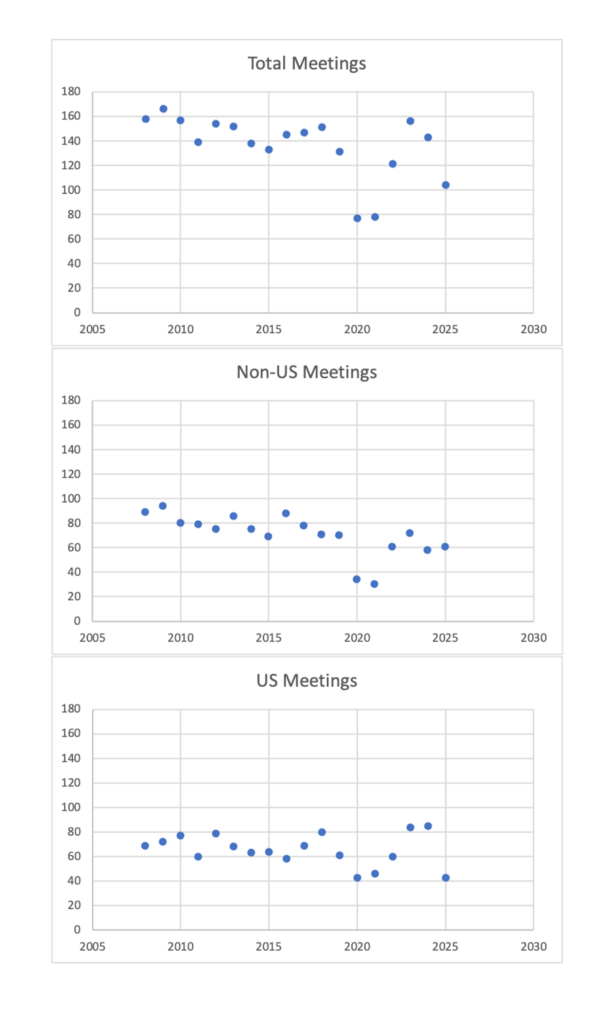
As founding editor of the Planetary Exploration Newsletter (PEN), I have kept my eye on planetary-related meetings around the world. PEN is a free weekly service providing information on conferences, jobs, funding, and other announcements to the international planetary community (https://planetarynews.org). Since 2007, we have provided the Planetary Meeting Calendar and we strive for completeness. In plotting up the number of meetings every year since 2008 (see below), it is interesting to see fairly constant level of total meetings for a number of years. US and Non-US meetings are not totally decoupled. Since there is much international collaboration in planetary science, groups of people will have some meetings alternate between US and non-US sites. Even major conferences like the AAS Division for Planetary Sciences conference will every few years have its meeting outside of the US (in 2025 it was jointly held with the Europlanet Science Congress in Helsinki). There was also the significant impact of COVID in 2020.
COVID forced us to experiment with remote versus in-person meetings. Tools were not unknown and with the advent of new and better web-based tools and the development of hybrid meeting formats (combining remote and face-to-face meetings), meeting frequency was back to near pre-pandemic levels within a few years, particularly in the US. In fact, the hybrid capability promoted even broader participation and possibilities.
In 2025, the US suffered a COVID-level decline in its planetary meetings. This is not reflected in non-US meetings. This is in part due to the suspension of some meetings in the face of overt US government hostility to Diversity, Equity and Inclusion. The government shutdown was not helpful. A significant factor is likely the inability of US scientists to plan in the face of so much uncertainty in their funding future and what NASA missions may survive. NASA has been withdrawing its support from major scientific conferences.
We will be continuing to track planetary-related conferences in the US and around the world. The current low level or further decline of US meetings will be a manifestation of the current US government plan to no longer be the international leader in solar system exploration, a position the United States has maintained for more than 60 years to the significant economic and political benefit of the United States. It may be the canary in the coal mine.
Note: All opinions are those of the author and not the Planetary Science Institute.