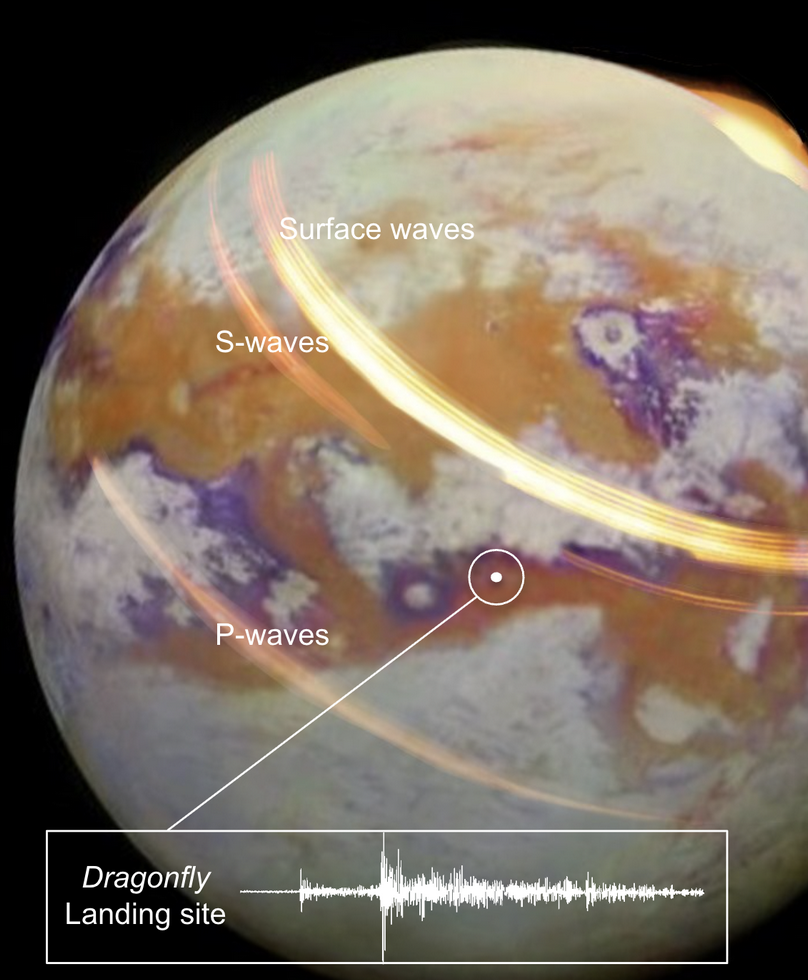
What lies beneath the surface of Titan, Saturn’s largest moon? This question is central to the upcoming Dragonfly mission, which will deploy a drone equipped with scientific instruments on Titan’s surface in the coming years. Among them is a seismometer designed to record ground vibrations. But does Titan shake enough for such instruments to detect anything meaningful? A new study led by an international team, including researchers from the Institut de Physique du Globe de Paris, provides new insights. By combining seismic modelling, geology, and materials physics, the researchers explored the conditions under which icequakes; generated by tidal forces exerted by Saturn; could be detected at Titan’s surface.
As on the Moon or the icy moons of Jupiter, gravitational stresses acting on Titan can trigger fractures within its ice shell. These “icequakes”, analogous to earthquakes on Earth, generate seismic waves that propagate through the moon’s interior. However, unlike on Earth, these waves must travel through an icy envelope whose properties; temperature, porosity, and structure; remain largely unconstrained.
The study shows that this propagation is accompanied by strong signal attenuation, particularly at high frequencies. An additional challenge comes from Titan’s environment itself: its dense atmosphere, stirred by winds and turbulence, generates background noise that can mask seismic signals. In the most unfavourable scenarios, even the most energetic waves could go undetected.
Yet there is reason for optimism. The researchers identify a particularly promising observation window between 0.5 and 1 Hz, where certain seismic waves remain detectable. In particular, reflections within the ice shell; effectively seismic “echoes” produced by waves bouncing back and forth; emerge as a key signature. Analysing these echoes could allow scientists to estimate the thickness of the ice shell, thereby constraining the depth of the suspected subsurface ocean, or even confirming its existence.
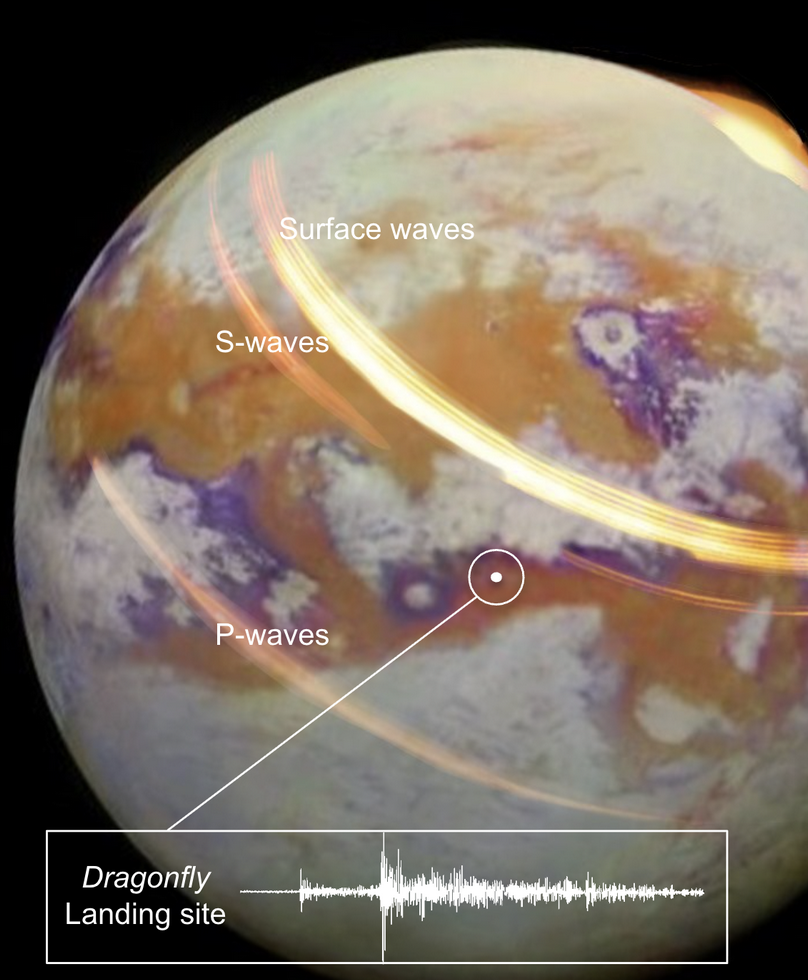
Even with a single seismometer, such as the one aboard Dragonfly, these observations could yield valuable information. The study shows that Titan’s internal structure; especially the thickness of its ice shell; leaves a direct imprint on the shape and timing of the recorded signals.
Beyond the mere detection of seismic activity, this work provides a realistic framework for interpreting future data from Dragonfly. By integrating plausible geological source models, internal structures consistent with observations from the Cassini–Huygens mission, and realistic scenarios of noise and attenuation, it helps define the conditions under which Titan’s interior may “reveal itself” through its vibrations.
These results reinforce the idea that planetary seismology is a unique tool for exploring icy worlds across the Solar System. On Titan, where direct access to the interior is impossible, listening to seismic activity may well be the key to understanding its structure, its evolution, and perhaps even its potential habitability.
Reference: L. Delaroque, T. Kawamura, A. Lucas, S. Rodriguez, K. Onodera, H. Shiraishi, R. Yamada, S. Tanaka, M. P. Panning, and R. D. Lorenz (2026). Investigating the Detectability of Body Wave Phases from Tidal Ice Cracking Events on Titan with the Dragonfly Short-Period Seismometer, JGR-Planets. DOI: 10.1029/2025JE009432