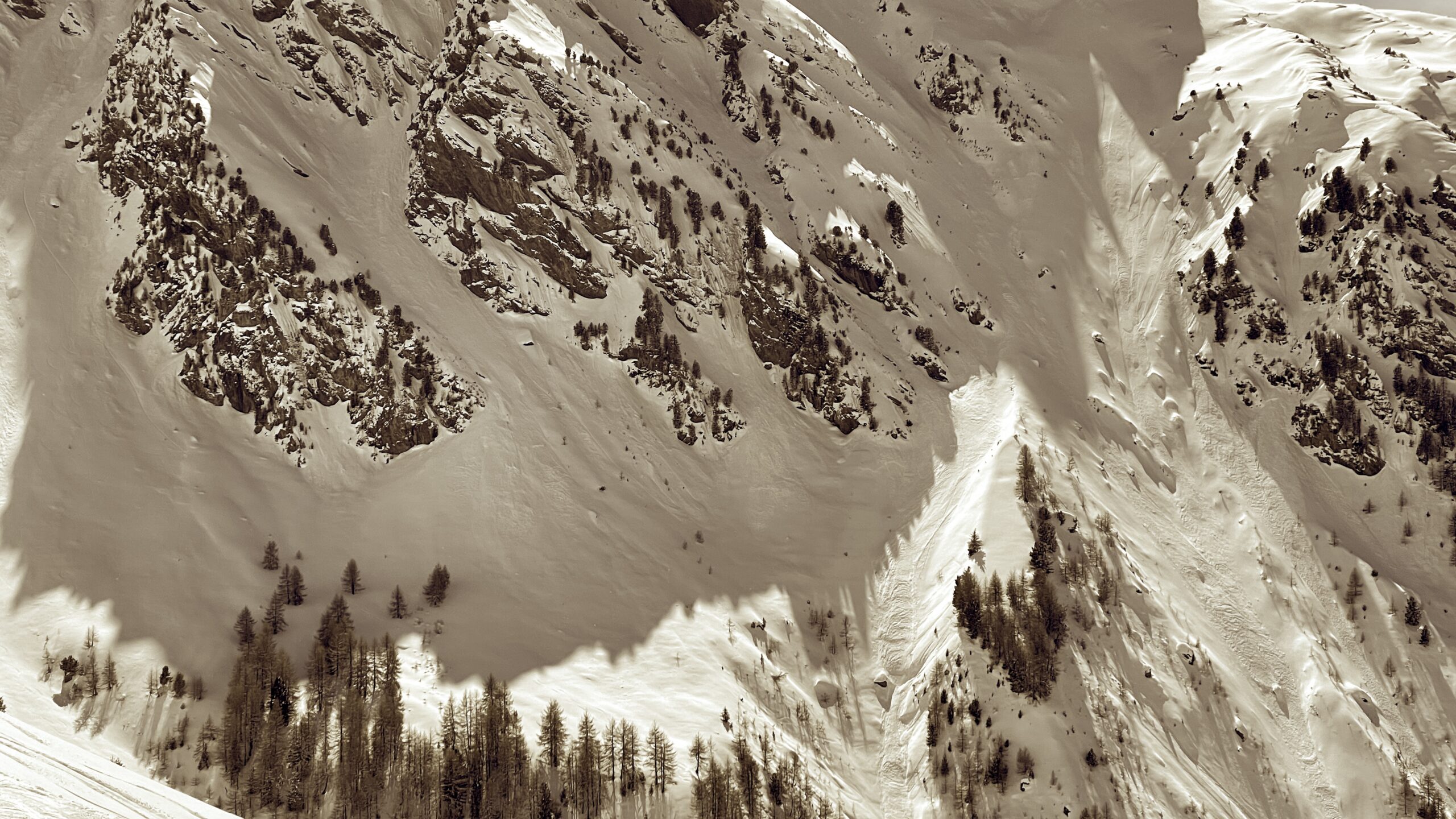
An experiment in a French avalanche couloir offers a practical way to test how seismic signals weaken in icy materials, with implications for exploring worlds far beyond Earth.
At La Norma, in Villarodin-Bourget, France, a team deployed a small seismic network in an avalanche environment. Designed to investigate seismic signals associated with mountain processes, the experiment also provided an opportunity to examine how those signals change across a natural snowpack. This field comparison forms part of the supporting information accompanying the recent study, led by Lorraine Delaroque and published in Earth and Space Science.
Listening across a snowpack
Four vertical geophones, separated by approximately 26 to 104 metres, recorded signals including a snow groomer and a triggered avalanche. Comparing their frequency content between stations allowed us to estimate an effective attenuation law over the 2–40 Hz band. The analysis recovered a quality factor, Q, that increases with frequency: the fractional energy loss per oscillation decreases across the analysed band. The comparison with their ice model was strongly sensitive to the assumed temperature, illustrating why field measurements need to be accompanied by information about the material through which waves travel. These observations provide an independent check on the broad attenuation magnitudes predicted by the model. They also reveal the challenges of making that comparison in a real mountain environment.
What does a weaker signal actually mean?
Seismic waves can weaken for several reasons. Internal friction converts some of their energy into heat. Heterogeneity scatters energy away from the direct wave. Propagation geometry, local ground conditions and sensor coupling also affect the recorded amplitude. The snowpack measurements combine these effects. Snow is porous, layered and granular, whereas the model describes intrinsic dissipation in compact crystalline ice. The experiment therefore provides an exploratory consistency check, rather than a direct measurement of the model’s intrinsic ice properties. That distinction helps define the next experiments. Repeated sources at known locations, better constraints on propagation paths, and measurements of snow temperature, density and layering could help separate material dissipation from other causes of amplitude change. This is a route towards more demanding field tests of attenuation models.
Why this matters for icy moons
The published model connects seismic energy loss to physical processes within ice, including dislocation motion, grain-boundary sliding and proton reorientation. Their contributions change with temperature and frequency, affecting which signals might reach a seismometer. For planetary exploration, the consequences are substantial. In the Titan simulations presented in the paper, later seismic arrivals can be around ten times weaker than in a commonly used lower-attenuation model. Those arrivals carry information about the interior, but that information is only accessible if the signals remain detectable. An Alpine snowpack cannot reproduce the conditions inside an icy moon. It can, however, provide an accessible testing ground for the methods used to interpret seismic amplitudes in complex icy environments. Alongside laboratory experiments, such observations can help build more realistic predictions for future seismic exploration; including Dragonfly’s investigations on Titan.
Read the study in Open Access: Delaroque, L., Lucas, A., Kawamura, T., & Rodriguez, S. (2026). A Physics-Based Frequency-Temperature Seismic Anelastic Attenuation Model for Planetary Ice Shells. Earth and Space Science, 13, e2026EA005178. The field experiment is described in Supporting Information, Text S6.