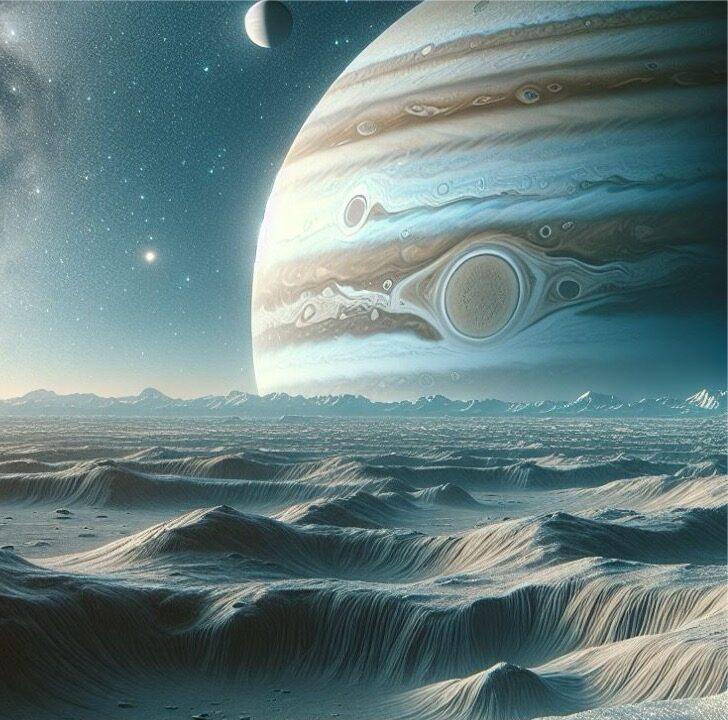
The exploration of icy moons in the outer Solar System is entering a transformative era, building on the legacy of the Galileo mission at Jupiter and Cassini at Saturn, and driven by upcoming missions such as ESA’s JUICE, NASA’s Europa Clipper, and Dragonfly, as well as future mission concepts targeting Enceladus. These efforts offer unprecedented opportunities to investigate the surface, exospheric, and magnetospheric environments of icy moons, significantly advancing our understanding of their geophysical processes, habitability, and astrobiological potential.
Despite this progress, important gaps remain in our ability to connect surface processes with their surrounding plasma, radiation, and neutral environments, and to understand how these coupled interactions operate across multiple spatial and temporal scales. Addressing these challenges is essential for a more comprehensive view of ocean worlds.
In this context, this Special Issue on icy moons’ surface–environment interactions, to be published in Planetary Research, builds directly on the “Jovian Icy Moons: Surface–Environment Interactions” workshop held at ESAC in November 2025 (https://www.cosmos.esa.int/web/jovian-icy-moons-surface-interactions-with-their-environment), which brought together researchers working on surface, exospheric, and magnetospheric processes. The workshop fostered interdisciplinary exchange and highlighted recent advances from remote sensing, laboratory experiments, and numerical modeling. Building on this momentum, the Special Issue aims to extend and consolidate these discussions by highlighting recent advances in our understanding of these complex systems across both Jovian (Europa, Ganymede, Callisto) and Saturnian moons (Enceladus, Titan, Dione, Tethys, Rhea, and Mimas).
We invite contributions addressing surface processes, chemistry and composition, exospheric and plume dynamics, radiation-driven processes, laboratory and analogue studies, mission synergies and astrobiological perspectives. Interdisciplinary studies that combine observations, experiments, modeling and explore surface–environment coupling, assess biosignature preservation or develop cross-mission strategies in support of the search for life on icy worlds are particularly encouraged, including studies related to upcoming missions such as ESA’s JUICE and NASA’s Europa Clipper and Dragonfly. The deadline for submission of contributions is set to 1 september 2026.
For expressions of interest or further information, please contact:
guillaume.cruz-mermy@universite-paris-saclay.fr and rozenn.robidel@esa.int