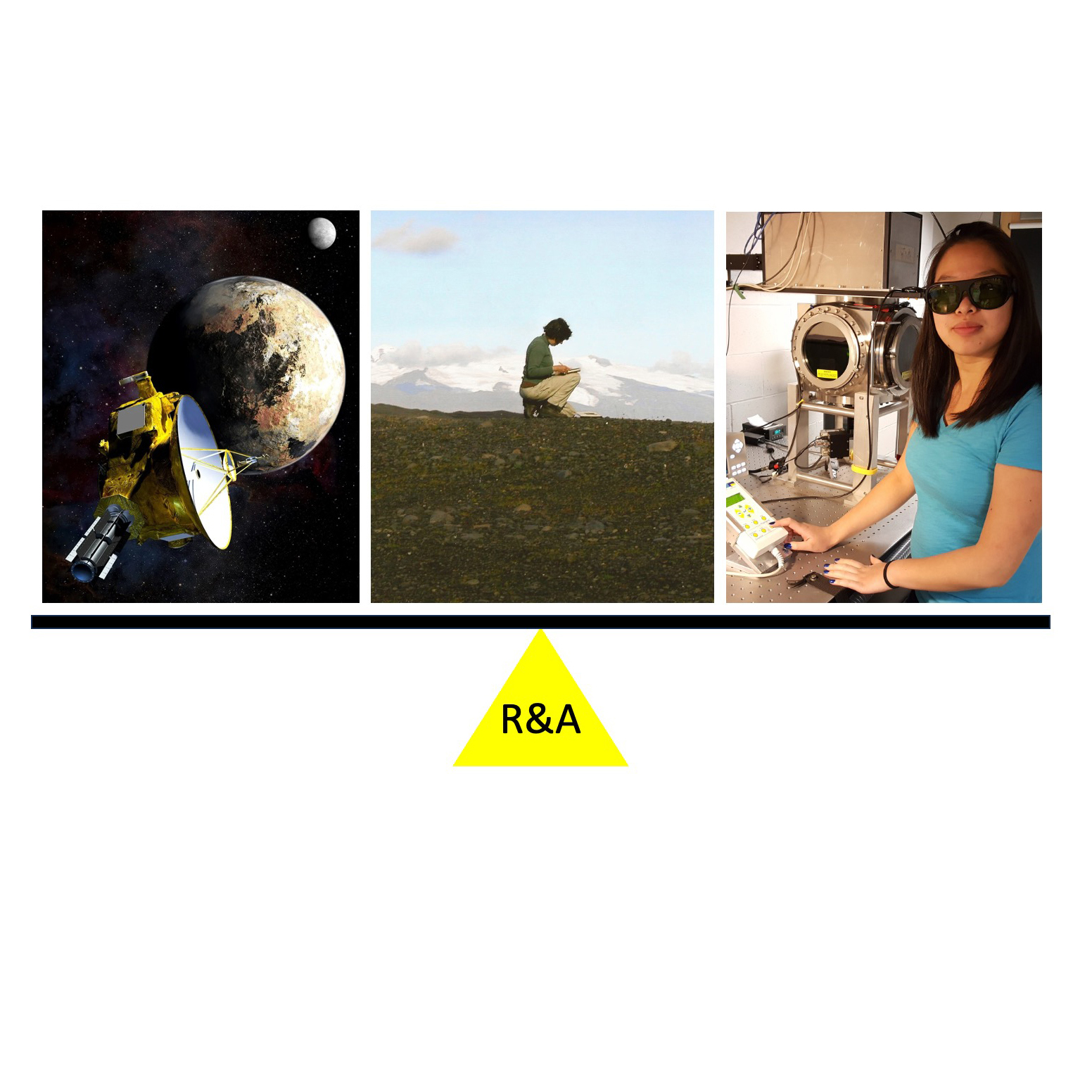
Detailed budget information obtained through Freedom of Information Act requests, Presidential Budget Requests and other sources within the government reveals that NASA has systematically failed to implement decades of recommendations by the National Academies as well as directives by Congress to grow the funding of planetary research and analysis programs (R&A) and meet specific funding targets. For decades it has been recognized that these programs are foundational to our nation’s Solar System exploration program. They have been a direct source of new knowledge about the physical and biological worlds that are of value to the nation, they have created the bases on which flight projects have been justified, they have provided continuing value from flight project data through ongoing analysis and synthesis, and they have grown and sustained the community of scientists necessary to make all this possible and to establish the United States as the world leader in the exploration of the Solar System.
Our destinations and ambitions in the Solar System have greatly expanded over time and now even extend to solar systems around other stars. This has fueled the ongoing need to expand the subject matter coverage and depth of the planetary R&A programs. This need has been acknowledged in reports by the National Academies and in Congressional authorizations for NASA, which recognize that activities funded by R&A programs are essential to NASA’s science enterprise. Instead of growing R&A, records show that NASA has effectively flat-funded it for 15 years, between FY 2011 and 2025. In the meantime, inflation has reduced the value of that funding by more than 30%. The consequences are devastating. NASA is losing the intellectual content needed to identify and answer the breadth of significant scientific questions it is faced with today and it is losing the community of scientists (young and old) our nation needs to pursue these questions and maintain leadership in the world. When coupled with huge cuts to science proposed by the Administration, the discouragement of foreign students from all nations and international collaborations, and the deep reductions in experienced NASA personnel that has already occurred over the past year and a half, the US may not recover.
What are R&A Programs?
Traditionally, R&A programs provide openly competed funds for investigator-led basic research and spacecraft data analysis. These grants are generally awarded to universities, non-profit research institutes, and even NASA centers. R&A does not include mission-supported research (e.g., mission science teams), internally directed work by NASA, and internally funded work by NASA (which is not openly competed). Since 2013, instrumentation and technology development is not included in R&A as they have been distinguished by the National Academies as an activity deserving of its own priority and level of recommended funding.
Unlike space missions, which have high public visibility, the public rarely hears about R&A programs. The research they fund often results in news stories that get covered in the press, like Pluto’s thinning atmosphere (continuing to inform the interpretation of New Horizons data), mapping water at mid-latitudes on Mars (of interest to future human activity there), reliably predicting the plasma density in Jupiter’s magnetosphere (understanding the operational environment within which spacecraft will be searching for life in Europa). Funding of this work might be attributed to NASA if space allows, but specific funding programs are rarely mentioned.
Also unlike space missions, the R&A programs in the aggregate do not have a single budget line in the President’s Budget Request. Individual R&A program elements are in fact scattered across a number of budget categories that appear in the President’s Budget Request. Within the Planetary Science budget, these categories include Planetary Science Research, Lunar Discovery and Exploration, Discovery (a class of ‘smaller’ missions), New Frontiers (a class of ‘medium’ missions), Mars Exploration, and Outer Planets and Ocean Worlds. Over time, some R&A program elements may be jointly funded by different budget categories. An R&A program element may move from one budget category to another. Sometimes an R&A program element may be cancelled or merged with others to form a new program element. This makes it more challenging to monitor the health of these programs in the aggregate as well as their accomplishments, but NASA could easily do this.
All planetary R&A program elements examined in this report are described in Appendix A, which also includes a description of historical reorganizations.
To explore the boundaries of planetary R&A, I am also including a separate consideration of adding Participating Scientist Programs (PSPs) and their equivalents, the NASA Astrobiology Institute (NAI), the NASA Lunar Science Institute (NLSI) and its successor, the Space Science Exploration Research Virtual Institute (SSERVI). A description of all these program elements are given in Appendix B. It will be seen that PSPs are primarily focused on mission support, hence are not a good fit in general to be considered R&A. The NAI, NLSI and SSERVI do support work that would be considered R&A, but they also provide unknown levels of support for NASA center activity.
Budget information for all of these programs and program elements are gathered in the linked spreadsheet (RA_Funding_2011_2025), where R&A program elements are identified by yellow backgrounds and other programs to be considered are identified by light green backgrounds. To provide programmatic context for R&A program elements (and the other considered programs), a complete budgetary breakdown of the NASA Planetary Science Division Budget is given for the fiscal years 2011-2025, largely derived from Presidential Budget Requests. Summaries for each fiscal year are provided in Appendix C and the spreadsheet (RA_Funding_Summary).
Recommendations by the National Academies and Congress
In 1990, the Augustine Committee recognized that “space science” was the literal fulcrum of the American civilian space program (1). In 1998, an Academy panel noted that while NASA flight projects were highly visible and the most costly elements of space science, that R&A and mission-related data analysis programs defined the clear scientific goals and questions of missions, developed necessary technology, and generated the resultant knowledge (2). The decline in the fraction of the NASA budget funding this broader collection of programs was considered harmful to the “quality and productivity of NASA’s investment in science,” and that these programs needed to be “integrated more consciously into NASA’s strategic management practices” (2).
American Solar System exploration was rapidly expanding in the 1990s and 2000s with the creation of the competed Principal Investigator-led small-class missions called Discovery and the competed Principal Investigator-led medium-class missions called New Frontiers. In the midst of this, in 2002 the first Academy-led Solar System Exploration decadal survey was conducted to define priorities for this American enterprise (3). It also benefited from significant planetary science community involvement (4). This survey found that
“A healthy research and analysis (R&A) program is the most basic requirement for a successful program of flight missions. The SSE Survey recommends an increase over the decade in the funding for fundamental research and analysis programs at a rate above inflation that parallels the increase in the number of missions, amount of data, and diversity of objects studied.” (bold in original)
They found that an appropriate funding level for the R&A program would be 25% of the overall planetary flight mission budget. At the time, this was inclusive of technology development programs.
In 2011, the second Solar System Exploration decadal survey (5) recognized that it was presuming that funding would be available at a level sufficient to realize their recommendations and that prioritization of their recommendations was needed. The centrality of the R&A programs relative to other activities was provided in the following guidance:
“It is also possible that the budget picture could be less favorable than the committee has assumed. If cuts to the program are necessary, the first approach should be descoping or delaying Flagship missions. Changes to the New Frontiers or Discovery programs should be considered only if adjustments to Flagship missions cannot solve the problem. And high priority should be placed on preserving funding for research and analysis programs and for technology development.”
They made the specific funding recommendation for R&A programs:
“The committee recommends that NASA increase the research and analysis budget for planetary science by 5 percent above the total finally approved FY2011 expenditures in the first year of the coming decade, and increase the budget by 1.5 percent above the inflation level for each successive year of the decade.” [First year of the decade was FY2013]
It also recommended that planetary exploration technology develop be funded at “approximately 6 to 8 percent of the total NASA Planetary Science Division budget” and that it be “carefully protected against all incursions that would deplete its resources.”
In 2022, the latest Solar System Exploration decadal survey (6) recommended that:
“The Planetary Science Division (PSD) should increase its investment in research and analysis (R&A) activities to achieve a minimum annual funding level of 10 percent of the PSD total annual budget. This increase should be achieved through a progressive ramp-up in funding allocated to the openly competed R&A programs, as defined in this decadal survey. Mid-decade, NASA should work with an appropriately constituted independent group to assess progress in achieving this recommended funding level.” [Mid-decade will be FY 2027]
Consistent with what is used in this report, the decadal survey notes:
“to understand the health of the PSD’s R&A portfolio, what matters most are the openly competed programs that fund observations, data and sample analyses, and fundamental research. These programs are open to all proposers, allowing for broad access, and are highly competitive, which drives innovation. Not included in the committee’s definition of openly competed R&A programs is funding received by co-investigators on directed or principal investigator (PI)-led mission science teams. Internally allocated civil servant funding (ISFM) is also excluded.”
It should be noted that Congress has for decades recognized that research and analysis grant programs were part of maintaining a balanced space science portfolio for NASA and that NASA should be following the guidance of the National Academies decadal surveys (7,8). In 2022, in Public Law No: 117-167 (CHIPS and Science Act), Congress articulated the high need of the Research and Analysis grant programs in more detail and set an ambitious goal for their funding level, applying it to all Science Mission Directorate divisions, on a more aggressive schedule than the decadal survey:
“Sec. 10821
(a)(2) the Research and Analysis programs funded by the Science Mission Directorate are critically important for –
(A) preparing the next generation of space and Earth scientists;
(B) pursuing peer-reviewed cutting-edge research;
(C) maximizing scientific return from the Administration’s space and Earth science missions; and
(D) developing innovative techniques and future mission concepts.
(b) Goal. – The (NASA) Administrator shall pursue the goal of establishing annual funding for Research and Analysis in the Science Mission Directorate that reaches a level of not less than 10 percent of the total annual funding of relevant divisions of the Science Mission Directorate by fiscal year 2025.”
R&A Funding, 2011-2025
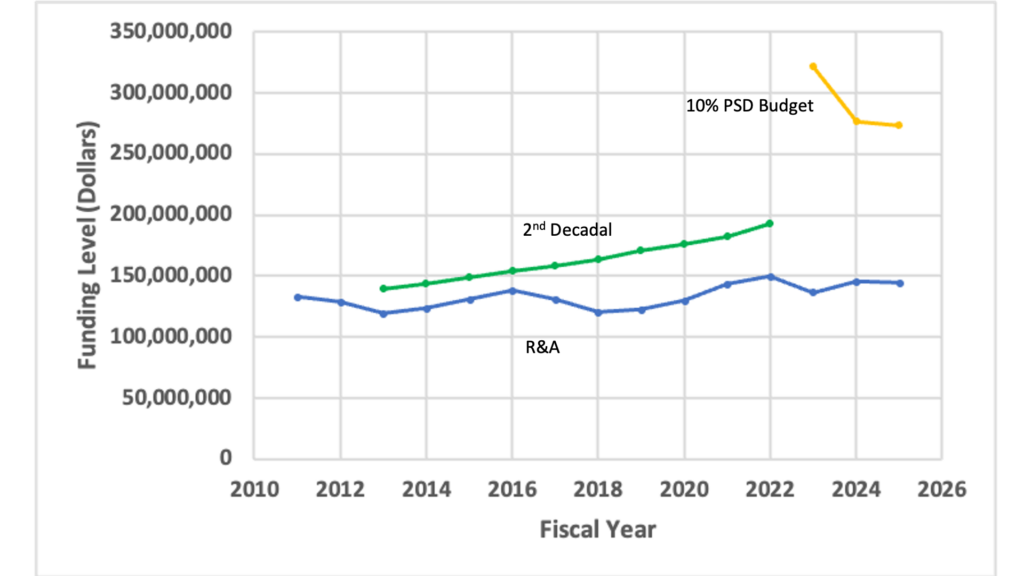
In Fig. 1 we see that the R&A program funding has never met the recommendations of the second decadal survey, increasingly diverging until in 2022 it is low by about 22%. The discrepancy is more divergent for the Congressional goal of reaching 10% of the Planetary Science Division budget by 2025 by almost 50%.
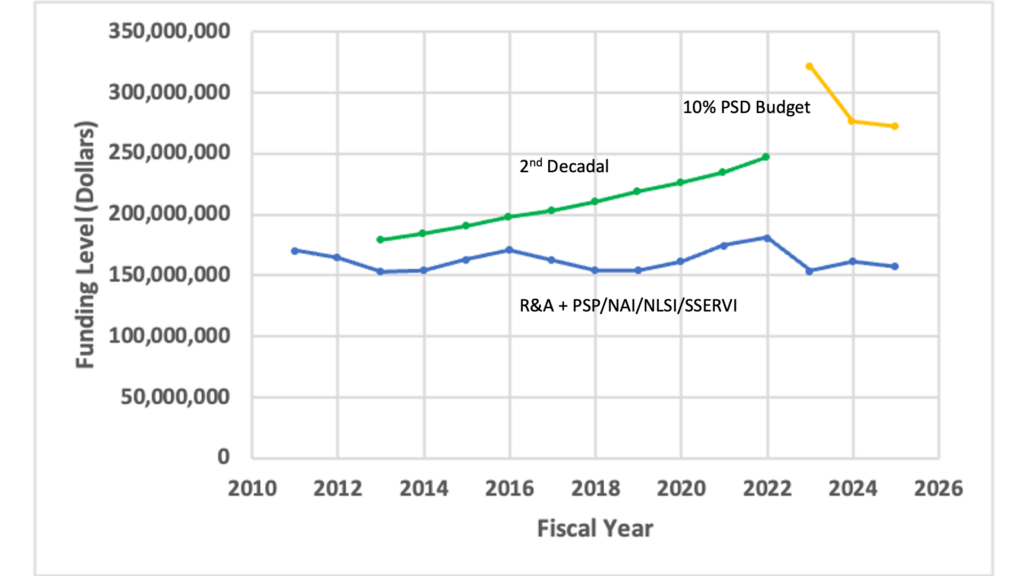
In Fig. 2, we have included Participating Scientist Programs and the NASA Astrobiology Institute, NLRI, and SSERVI with the R&A programs. While this increases the total funding, it still fails to reach the decadal recommendations by 27% and is still more than 40% below the Congressional goal of reaching 10% of the Planetary Science Division budget by 2025.
In both scenarios, the impact of this failure is worsened when taking into consideration that from 2011 to 2025 the value of R&A funding has declined by 30% per the Consumer Price Index and by 32% using the NASA New Start Inflation Index (actuals thru September 2025). The loss of science being generated by these programs has been substantial.
Recalling the guidance of the first decadal survey, we note that 25% of the overall planetary flight mission budget in 2024 would have been over $450,000,000.
Recommendations
In 2017, an NRC committee examined mid-term compliance by NASA with the second Decadal Survey recommendations (9). During its meetings, NASA provided funding profiles for the R&A programs (2011-2016) to demonstrate their success in meeting and exceeding their determination of the corresponding decadal recommended funding levels. The accuracy of their numbers was challenged several times and over the course of several months, three different R&A funding profiles were provided by the agency with deviations as much of 50%. The program elements used in each case were not revealed. This was laid out in my testimony before Congress in 2019 (https://science.house.gov/hearings/discovery-on-the-frontiers-of-space-exploring-nasas-science-mission).
For 15 years, NASA has failed to comply with decadal recommendations and specific congressional direction for funding R&A, while at the same time obfuscating their lack of compliance. This calls for a Congressional remedy.
Congress should provide a specific definition for the nature of programs to be called “research and analysis (R&A)” that NASA must follow. This definition should be essentially “R&A programs provide funding for openly competed, investigator-led basic research and spacecraft data analysis proposals.” Congress should require that the NASA Administrator, within 90 days of the end of each fiscal year, provide a report to Congress and public that includes the expenses accrued in each R&A program element along with the budget for that program element for that year. The sum of those values should also be provided and compared with the NASA Planetary Science Division budget for that year so that compliance with Congressional and decadal survey recommendations can be independently determined. Within that same report, NASA should include a summary discussion of how R&A advances PSD’s strategic objectives, lays the groundwork for future space science efforts, and enhances the return on science mission investments. This could be supported by including a list of all peer-reviewed publications generated by projects in that year and other notable results supported by each program.
Mark V. Sykes
Senior Scientist and Former CEO
Planetary Science Institute
NOTE: All opinions are those of the author and not the Planetary Science Institute.
REFERENCES
- Advisory Committee on the Future of the U.S. Space Program (1990). Report of the Advisory Committee on the Future of the U.S. Space Program. Washington, D.C.: U.S. National Aeronautics and Space Administration.
- National Research Council (1998). Supporting Research and Data Analysis in NASA’s Science Programs: Engines for Innovation and Synthesis. Washington, DC: The National Academies Press.
- National Research Council (2003). New Frontiers in the Solar System: An Integrated Exploration Strategy. Washington, DC: The National Academies Press.
- The Future of Solar System Exploration, 2003-2013 – Community Contributions to the NRC Solar System Exploration Decadal Survey (M.V. Sykes, Ed.). ASP Conference Proceedings, Vol. 272. San Francisco, Astronomical Society of the Pacific, 2002. 433 pgs.
- National Research Council (2011). Vision and Voyages for Planetary Science in the Decade 2013-2022. Washington, DC: The National Academies Press.
- National Academies of Sciences, Engineering, and Medicine (2022). Origins, Worlds, and Life: A Decadal Strategy for Planetary Science and Astrobiology 2023-2032, Washington, DC: The National Academies Press.
- Public Law No. 111-267 National Aeronautics and Space Administration Authorization Act of 2010 (Secs. 803 and 805).
- Public Law No. 115-10 National Aeronautics and Space Administration Transition Authorization Act of 2017 (Sec. 501)
- National Academies of Sciences, Engineering, and Medicine (2018). Visions into Voyages for Planetary Science in the Decade 2013-2022: A Midterm Review. Washington, DC: The National Academies Press.
- National Academies of Sciences, Engineering, and Medicine. 2017. Review of the Restructured Research and Analysis Programs of NASA’s Planetary Science Division. Washington, DC: The National Academies Press.
SOURCE DOCUMENTS RECEIVED FROM NASA THRU FOIA AND ONLINE
11-HQ-F-01230 RESPONSIVE DOCUMENT (18).xlsx
122112_Green_report_to_PSS.pdf
21-HQ-F-00103 2017 to 2019 Budget.xlsx
21-HQ-F-00103 2019 to 2020 Budget.xlsx
Planetary FOIA Report 2-1-21.xlsx (part of 21-HQ-F-00103 response)
26-00736-F-HQ Final Determination Package.pdf (May 5, 2026)
26-00736-F-HQ Updated Response.xlsx (June 16, 2026)
APPENDIX A – R&A Program Descriptions
Descriptions of programs are largely pulled and condensed from the NASA omnibus research funding opportunity Research Opportunities in Space and Earth Science (ROSES). Citations are given as (ROSES-YEAR) where YEAR is the year in which the NASA research announcement is released. Funding for successful proposals is generally provided in the following fiscal year. Program descriptions can remain relatively unchanged for many years. All of these announcements can be found on the NASA Solicitation and Proposal Integrated Review and Evaluation System (NSPIRES).
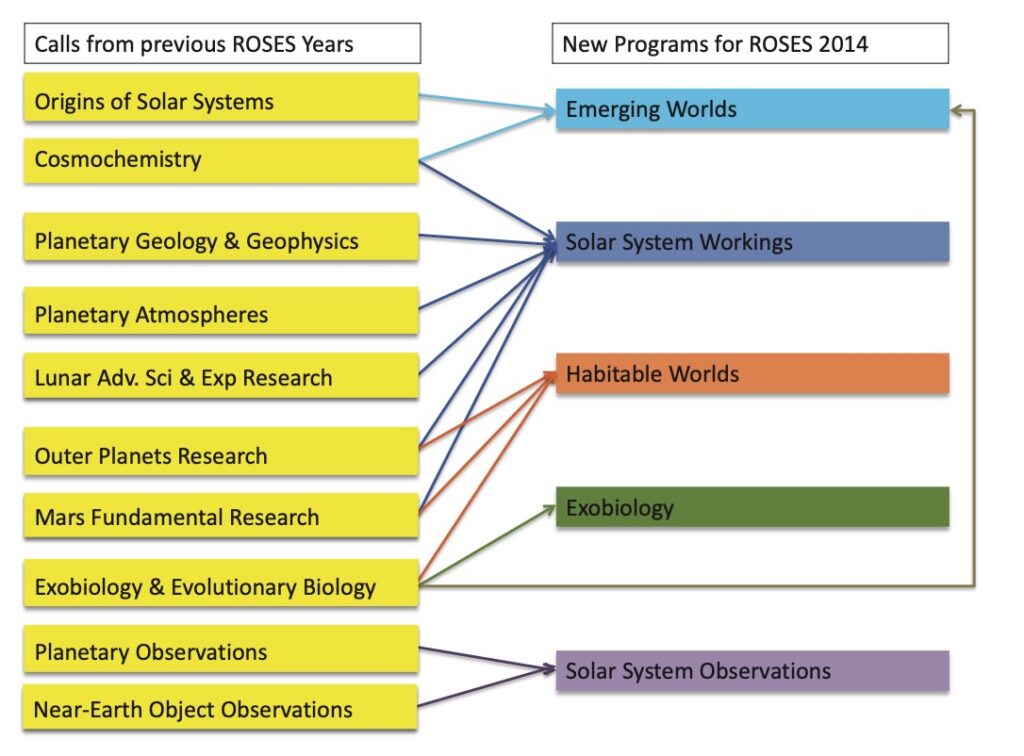
In 2014, planetary R&A program elements were reorganized into new program elements that were meant to be more thematic in character (Fig. 3). Funding of some of the earlier programs would continue, overlapping with new program elements, for a few years, presumably for accounting purposes because of multi-year awards. Some new programs, like Solar System Observations, continued to be bookkept under the older program element name (Planetary Astronomy – not Planetary Observations). In 2025, there was another massive reorganization in which all of the new ROSES-2014 programs were merged with other programs, including data analysis programs, into Solar System Science against which expenses would start to be accrued in 2026.
Analog Activities to Support Artemis Lunar Operations (Lunar Analog Activities)
This program addresses NASA’s planetary science goal to “ascertain the content, origin, and evolution of the solar system, and the potential for life elsewhere” by preparing us to maximize science during the human exploration of planetary bodies. The focus of this program is on supporting high-fidelity science operations and operations constraints through planetary field campaigns, specifically the Desert Research and Technology Studies (D-RATS) field campaign. Funding provided is intended to enable researchers to participate as science team members in the planning, execution, and analysis of D-RATS. (ROSES-2021)
Astrobiology Science and Technology for Exploring the Planets (ASTEP)
Future astrobiological research associated with solar system exploration requires the development of astrobiologically relevant, miniaturized instrumentation capable of extensive operations on lunar and planetary surfaces throughout the Solar System. This program solicits proposals for investigations focused on exploring the Earth’s extreme environments in order to develop a sound technical and scientific basis to conduct astrobiological research on other solar system bodies. This is a science-driven exploration program that is expected to result in new science and operational/technological capabilities to enable the next generation of planetary exploration. A unique and central feature is the use of terrestrial field campaigns to further science and technology and NASA’s exploration capabilities. (ROSES-2010)
Cassini Data Analysis Program (CDAP)
Enhance the scientific return of the Cassini mission by broadening the scientific participation in the analysis and interpretation of the data returned by the mission. This program solicits research proposals to conduct scientific investigations utilizing data obtained by the Cassini and Huygens spacecraft, focusing on the Saturn system. (ROSES-2010) It is noted that a Cassini Participating Scientist Program is imbedded in CDAP for ROSES-2011 through ROSES-2015. Since the relative amounts are not separable in available budget information, the entirety of the program is included as a part of R&A.
Citizen Science
Citizen science is a form of open collaboration in which individuals or organizations participate voluntarily in the scientific process. The Citizen Science Seed Funding Program (CSSFP) of NASA’s Science Mission Directorate (SMD) aims to support scientists and other experts to develop citizen science projects and to expand the pool of professional scientists who use citizen science techniques in their science investigations. (ROSES-2020)
Cosmochemistry
Supports investigations of extraterrestrial materials that are aimed at understanding the geochemistry of the Solar System bodies (planets, satellites, including the Earth’s Moon, and small Solar System bodies). The goal is to increase the understanding of the chemical origin of the Solar System and the processes by which its planets and small bodies have evolved to their present states. NASA is particularly interested in proposals for sample-focused research projects that closely support its missions for exploring the Solar System or that contribute to the development of future missions. Individual investigations may contribute new data, analyze and synthesize existing data, or combine both kinds of activities. Examples of the kinds of research supported by this program include: Measurements of mineral compositions, major and trace element chemistry, isotopic compositions, radiometric ages, magnetism, or radiation exposure effects; Petrologic studies of extraterrestrial materials; Laboratory studies of phase stability, chemical partitioning, and other processes necessary to interpret planetary data; and Synthesis of previously obtained geochemical data. (ROSES-2010)
Discovery Data Analysis Program (DDAP)
Advances the planetary sciences through research based on select missions of NASA’s Discovery Program, ESA’s Rosetta and BepiColombo missions, and select other missions with important synergies with the Discovery program. DDAP’s objectives are to enhance the scientific return of these missions by supporting new analyses, approaches, and interpretations of data and samples. (ROSES-2014)
Emerging Worlds (EW)
Scientific investigations related to understanding the formation and early evolution of our Solar System. It covers the physics and chemistry of events and materials that are relevant to the formation of planets, satellites, and minor bodies, including dust, and to the early history of these bodies. For the purposes of this solicitation, formation encompasses events and processes that result in a significant change to the physical or chemical structure of the solar system, the inventory of bodies in the solar system (planets, satellites, minor bodies, rings, and dust), or the distribution of bodies in the solar system. This may be addressed through studies of our solar system, as well as planetary systems in general. A wide range of investigations will be covered, including, but not limited to, theoretical studies, analytical and numerical modeling, sample-based studies of extraterrestrial materials, laboratory studies, and synthesis of previous work. (ROSES-2014)
Exobiology & Evolutionary Biology (EXO)
The goal is to understand the origin, evolution, distribution, and future of life in the Universe. Research is centered on the origin and early evolution of life, the potential of life to adapt to different environments, and the implications for life elsewhere. This research is conducted in the context of NASA’s ongoing exploration of our stellar neighborhood and the identification of biosignatures for in situ and remote sensing applications. (ROSES-2010)
Exoplanet Research Planetary (XRP)
Basic research proposals to conduct scientific investigations related to the research and analysis of extrasolar planets (exoplanets). Its broad objectives include the determination of compositions, dynamics, energetics, chemical behaviors of extrasolar planets, and the detection and characterization of other planetary systems. (ROSES-2014)
Future Investigators in NASA Earth and Space Science and Technology (FINESST)
Through FINESST, the Science Mission Directorate (SMD) solicits proposals from accredited U.S. universities and other eligible organizations for graduate student-designed and performed research projects that contribute to SMD’s science, technology, and exploration goals. The Future Investigator (FI) i.e., the student participant, shall have the primary initiative to define the proposed FINESST research project and must be the primary author, with input or supervision from the proposal’s Principal Investigator (PI), as appropriate. The Planetary Science Research Program, managed by the Planetary Science Division, supports investigations to address the broad strategic objective to “Advance scientific knowledge of the origin and history of the solar system, the potential for life elsewhere, and the hazards and resources present as humans explore space” as described in NASA’s Science Vision. (ROSES-2019)
Habitable Worlds (HW)
Use knowledge of the history of the Earth and the life upon it as a guide for determining the processes and conditions that create and maintain habitable environments and to search for ancient and contemporary habitable environments and explore the possibility of extant life beyond the Earth. Identify the characteristics and the distribution of potentially habitable environments in the Solar System and beyond. This research is conducted in the context of NASA’s ongoing exploration of our stellar neighborhood and the identification of biosignatures for in situ and remote sensing applications. Theoretical and experimental studies will be considered, as well as quantitative terrestrial field experiments that improve scientific understanding of how in situ measurements at analog sites can or will improve our understanding of the potential for the environment to support life. Research areas include, but are not limited to, the presence of water and/or exotic solvents, sources of energy for life, presence of organics and their reactivity, and water body physics and chemistry as they pertain to habitability and habitability over time. (ROSES-2014)
Here to Observe
Underrepresentation in the field of planetary science is a known issue, with low proportions of historically marginalized groups participating in NASA Planetary Science Division (PSD) funded activities. As part of a multipronged strategy to address underrepresentation of historically marginalized groups in STEM, PSD has established this Here to Observe (H2O) program for undergraduate students from institutions not typically participating in NASA missions. The H2O Program is, in its simplest form, a monthly, 1-hour opportunity for undergraduate students to observe NASA PSD mission meetings/activities during the 9-month academic year, alongside mentors and peers. By opening doors to PSD missions and sharing the excitement of planetary exploration, H2O’s goal is to spark and maintain an interest for underrepresented students considering STEM careers. (ROSES-2023)
Interdisciplinary Consortia for Astrobiology Research (ICAR)
The goal of NASA’s Astrobiology program is the study of the origins, evolution, and distribution of life in the Universe. It is central to NASA’s continued exploration of our solar system and beyond. Research is centered on the origin and early evolution of life, the potential of life to adapt to different environments, and the implications for life elsewhere. Proposals for Interdisciplinary Consortia for Astrobiology Research (ICAR) must describe an interdisciplinary approach to a single compelling question in astrobiology, and address at least one aspect of the 2015 Astrobiology Strategy. (ROSES-2019)
Jupiter Data Analysis Program (JDAP)
Enhance the scientific return of the Jupiter science data obtained by the New Horizons spacecraft, as well as the Voyager, Galileo, and Cassini spacecraft, by means of a broad scientific participation in the analysis and interpretation of the data returned by these missions. A significant, not incremental, advance in our understanding of the Jupiter system must be proposed. (ROSES-2008)
Laboratory Analysis of Returned Samples (LARS)
Maximize the scientific return from the samples provided by planetary missions (e.g., Genesis, Stardust, Hayabusa, Genesis, Stardust, OSIRIS-REx) through development of laboratory instrumentation and advanced analytical techniques in addition to analyses of and analytical work on the returned samples. This program was formerly the Sample Return Laboratory Instrument and Data Analysis Program (SRLIDAP). (ROSES-2010)
Lunar Advanced Science and Exploration Research (LASER)
This program supports the broad spectrum of fundamental lunar science encompassing investigations of the lunar surface, interior, exosphere, and the Moon’s near-space environment. Investigations of Earth-Moon system processes and selenogenesis are equally welcome. Supported investigations include, but are not limited to, theoretical investigations, numerical modeling of physical or chemical processes, experimental/laboratory investigations, field analog studies, and combinations thereof. The spectrum of lunar science funded by LASER includes the following fields: geology, geochemistry, geophysics, exospheric science, solar wind environment history/physics, and radiation environment physics. This program also supports applied science that furthers the goals of the U.S. Space Policy and considerably advances NASA’s preparedness for conducting science on and from the Moon. Supported investigations include, but are not limited to, theoretical investigations, numerical modeling of physical and chemical processes, experimental/laboratory investigations, and field analog studies. While LASER is not designed to support large technology or instrument development projects, it is well suited for field activities that integrate technology, operational tests, and basic science to optimize scientific return from robotic and human missions to the Moon. (ROSES-2010)
Lunar Data Analysis (LDAP)
Research (e.g., scientific, landing site science, cartographic, topographic, geodetic research, etc.) on the analysis of recent lunar missions in order to enhance their scientific return. LDAP broadens scientific participation in the analysis of mission data sets and funds high-priority areas of research that support planning for future lunar missions. (ROSES-2015)
Mars Data Analysis Program (MDAP)
Enhance the scientific return from missions to Mars conducted by NASA and other space agencies. Studies (scientific, landing site science, cartographic, topographic, geodetic research) are based on analysis of Mars data collected by spacecraft at Mars. (ROSES-2010)
Mars Fundamental Research (MFR)
Innovative scientific research concerning atmospheric, climatological, geologic, geophysical, and geochemical, processes on Mar, beyond spacecraft data analysis alone. These include (i) theoretical and experimental studies, including laboratory studies of analog materials, to investigate the coupled atmospheric and geological systems on Mars; (ii) quantitative terrestrial field experiments that improve understanding of the in-situ measurements that have been or that will be made on Mars; and (iii) any other innovative research activities that demonstrate relevance to NASA’s overarching goals for the scientific exploration of Mars. (ROSES-2010)
Mars Multi-Mission DA & Data Products
Not separately described in ROSES, presumed to be bookkept under Mars Data Analysis Program
Moon Mars Analog Mission Activities Program (MAMMA)
This research addresses the need for integrated interdisciplinary field experiments as an integral part of preparation for planned human and robotic missions to the Moon and Mars. This includes, but are not limited to: 1) Understanding and optimizing human and robotic performance to maximize scientific return; 2) Defining science requirements for early lunar missions with humans, including requirements for mobility, navigation, communications, in situ analysis, surface laboratory functionality, crew scheduling, and sample acquisition, handling, documentation, and curation; 3) Developing surface science scenarios for use in architecture planning and science payload manifesting; and 4) Illuminating areas of critical importance for robotic precursor missions, including robotic operations of/with human-oriented systems during periods when humans may not yet be present. (ROSES-2010)
New Frontiers Data Analysis Program
The objective of the New Frontiers Data Analysis Program (NFDAP) is to enhance the scientific return from New Frontiers missions by broadening scientific participation in the analysis and interpretation of data returned by these missions. Other mission and non- mission data sets may be used to supplement these data in a supporting role, but all proposals require the use of data from at least one New Frontiers mission. (ROSES-2016)
Origins of Solar Systems
This program solicits basic research proposals to conduct scientific investigations related to understanding the formation and early evolution of planetary systems and to provide the fundamental research and analysis necessary to detect and characterize other planetary systems. These investigations may involve analytical and numerical modeling, laboratory research, and observational studies in the following areas: star formation and the relationship to planetary system formation, solar nebula processes, accumulation and dynamical evolution, analysis of primitive materials, and the detection and characterization of other planetary systems. (ROSES-2010)
Outer Planets Research Program (OPR)
Supports diverse scientific investigations that contribute to the understanding of the outer Solar System, including the giant planets, their satellites, and smaller solid bodies including comets, asteroids, and Kuiper Belt objects. The program includes both data analysis from NASA missions and fundamental research. (ROSES-2010)
Phoenix Data Analysis Program (Phoenix DAP)
Enhance the scientific return from the Phoenix lander mission (call solicited withing MDAP)
Planetary Astronomy
Support for both ground-based astronomical observations and suborbital investigations involving sounding rockets and balloons. Proposals are solicited for observations over the entire range of wavelengths from the ultraviolet to radio that contribute to the understanding of the general properties and evolution of the Solar System, its planets, their satellites, and of asteroids and comets. (ROSES-2010). In ROSES-2014, this program is renamed Solar System observations, but continues to be bookkept under Planetary Astronomy.
Planetary Atmospheres
Supports scientific investigations that contribute to the understanding of the origins and evolution of the atmospheres of planets (including exoplanets) and their satellites and of comets. Its broad objectives include the determination of compositions, dynamics, energetics, and chemical behaviors of planetary atmospheres. For example, investigations that may be submitted to this program are those that seek to study the sources and mechanisms for deposition of energy; the characterization and understanding of dynamical processes and circulation, both global and local; relationships between currently observed properties and/or states of matter including clouds, particles, and ices; interaction of atmospheres with the solar wind and the effects of magnetic fields both permanent and induced on these processes; interactions of planetary atmospheres with planetary surfaces; and the chemical abundance, physical conditions, and processes that may have prevailed at the time the planets were formed, as they pertain to atmospheres. (ROSES-2010)
Planetary Data Archiving, Restoration and Tools (PDART)
Generate higher-order data products, archive and restore data sets or products, create or consolidate reference databases, generate new reference information, digitize data, and develop or validate software tools. The objective is to increase the amount and quality of digital information and data products available for planetary science research and exploration, and to produce tools that would enable or enhance future scientific investigations. (ROSES-2014)
Planetary Geology and Geophysics (PGG)
Supports scientific investigations of planetary surfaces and interiors, satellites (including the Moon), satellite and ring systems, and smaller Solar System bodies such as asteroids and comets. The goals of the PGG program are to foster the synthesis, analysis, and comparative study of data that will improve the understanding of the extent and influence of planetary geological and geophysical processes on the bodies of the Solar System. Projects involve analysis and synthesis of existing data to investigate geological and geophysical processes and phenomena observed on natural objects within the Solar System. (ROSES-2010)
Planetary Mission Data Analysis Program (PMDAP)
Enhance the scientific return of historical Planetary Science Division missions no longer supported by data analysis programs by broadening the scientific participation in the analysis of archived data collected by those missions. In addition, this program supports the analysis of archived planetary data from other NASA SMD missions. (ROSES-2010)
Planetary Protection Research
This program solicits basic research proposals to conduct scientific investigations related to understanding the formation and early evolution of planetary systems and to provide the fundamental research and analysis necessary to detect and characterize other planetary systems. These investigations may involve analytical and numerical modeling, laboratory research, and observational studies in the following areas: star formation and the relationship to planetary system formation, solar nebula processes, accumulation and dynamical evolution, analysis of primitive materials, and the detection and characterization of other planetary systems. (ROSES-2010)
Planetary Science Early Career Award Program
The Planetary Science Early Career Award (ECA) program is intended to help promising young scientists play an increased and meaningful role in the planetary science community and pursue professional development in areas relevant to the Planetary Science Division (PSD). (ROSES-2019)
Planetary Science Early Career Fellowships (ECF)
This program supports the development of individual research programs of outstanding scientists early in their careers and stimulates research careers in the areas supported by the Planetary Sciences Division. This Program is based on the idea that supporting key individuals is a critical mechanism for achieving high impact science that will lead the field forward with new concepts, technologies, and methods. (ROSES 2010)
Planetary Science and Technology Through Analog Research (PSTTAR)
Future planetary research associated with solar system exploration requires the development of relevant, miniaturized instrumentation capable of extensive operations on lunar, asteroid, and planetary surfaces throughout the Solar System. To this end, investigations are focused on exploring the relevant environments on Earth (extreme environments that may be analogous to those found on other planets, past or present) in order to develop a sound technical and scientific basis to conduct planetary research on other solar system bodies. This is a science-driven exploration program that is expected to result in new science and operational/technological capabilities to enable the next generation of planetary exploration. This includes systems-level terrestrial field campaigns. (ROSES-2014)
Precursor Science Investigations for Europa (PSI-E)
The goal of this program is to further the understanding of critical topics in Europa exploration in advance of the Europa Clipper mission. This precursor work will provide critical context to enable more efficient analysis of Clipper data by the science community and will help generate discoveries and new questions that will feed into mission planning for the latter half of the prime mission and for any potential extended mission. This will maximize the science return from the radiation-limited lifetime of the Europa Clipper. (ROSES-2022)
Rosetta Data Analysis Program
The objective of the Rosetta Data Analysis Program (RDAP) is to enhance the scientific return of the Rosetta mission and broaden the scientific participation in the analysis of archived data collected from the Rosetta and Philae spacecraft. (ROSES-2017)
Solar System Workings (SSW)
Innovative scientific research related to understanding the atmospheric, climatological, dynamical, geologic, physical, and chemical processes occurring within the Solar System. This program is open to investigations relevant to surfaces and interiors of planetary bodies, planetary atmospheres, rings, orbital dynamics, and exospheres and magnetospheres. The program values the potential of interdisciplinary efforts to solve key scientific questions and also values research in comparative planetology. Research may include data synthesis, laboratory studies that examine physical or chemical properties and processes, studies of sample or analog materials of other Solar System bodies, field studies of terrestrial analogs of planetary environments, or theoretical and numerical modeling of physical or chemical processes. (ROSES-2014)
APPENDIX B – Additions to R&A Programs
Descriptions of programs are largely pulled and condensed from the NASA omnibus research funding opportunity Research Opportunities in Space and Earth Science (ROSES). Citations are given as (ROSES-YEAR) where YEAR is the year in which the NASA research announcement is released. Funding for successful proposals is generally provided in the following fiscal year. Program descriptions can remain relatively unchanged for many years. For the NASA Astrobiology Institute (NAI), NASA Lunar Science Institute (NLSI), and the Solar System Exploration Research Virtual Institute (SSERVI), descriptions are pulled and condensed from Cooperative Agreement Notices. All of these announcements can be found on the NASA Solicitation and Proposal Integrated Review and Evaluation System (NSPIRES).
DAWN at Ceres Guest Investigator Program (Dawn GIP)
The goals of the program are to: a) enhance the scientific return from the Dawn mission by broadening participation in the mission and b) augment the existing Dawn science team to include new members conducting investigations that broaden and/or complement the funded Principal Investigator (PI) and Co-Investigator (Co-I)-led investigations, thus maximizing the contribution of Dawn to the future exploration and scientific understanding of the Solar System. Selected Guest Investigators (GIs) will be treated as members of the Dawn science team and will work in a collaborative manner with other Dawn science team members after selection. (ROSES-2014)
Dawn at Vesta Participating Scientist Program (Dawn PSP)
The solicitation is for investigations to enhance the scientific return from the mission by augmenting the existing Dawn science team to include new investigations that broaden and/or complement the funded PI-led investigations, thus maximizing the contribution of Dawn to the scientific understanding of asteroids. Investigations will address one or more of the Dawn mission-level science objectives at Vesta: 1. Determine the origin and evolution of Vesta; 2. Characterize Vesta’s shape, topography, and spin state; 3. Determine and map Vesta’s surface composition and thermophysical properties; 4. Identify, map, and characterize geological and cratering processes and their chronology; 5. Test the link between Vesta and HED meteorites, and provide a geologic, compositional and geophysical context for them; 6. Determine the mass, density, gravitational field, and interior structure of Vesta; and 7. Search for dust and satellites in the environment of Vesta. (ROSES-2009)
Gravity Recovery and Interior Laboratory Guest Scientist Program (GRAIL GSP)
The goals of the program are to: a) enhance the scientific return from the GRAIL mission by broadening participation in the mission, and b) augment the existing GRAIL science team to include new members conducting investigations that broaden and/or complement the funded Principal Investigator (PI)-led investigations, thus maximizing the contribution of GRAIL to the future exploration and scientific understanding of the Moon. Selected Guest Scientists (GSs) will become members of the GRAIL science team and be required to fulfill some of the same responsibilities as those of current science team members. The selected GSs will coordinate their activities and analyses with the GRAIL Mission Project Scientist, Co-Investigators (Co-Is), and NASA Program Scientist, and they will be bound by team agreements. The selected GS activities and analyses will, thus, be coordinated with the GRAIL science team to achieve the essential scientific objectives of their GS investigation, within the scope and resources of the GRAIL project, and ensure dissemination of the results of the investigation to the scientific community and the general public. (ROSES-2011)
Hayabusa Participating Scientist Program (Hayabusa PSP)
To provide science investigations and operational support for the Japanese Hayabusa mission. (2003 TBD, MUSES-C Participating Scientist Program)
Hayabusa2 Participating Scientist Program (Hayabusa2 PSP)
Enhance the scientific return of the Hayabusa2 mission by broadening participation in the mission with NASA selected scientists, augmenting the existing science team to include new investigations that enhance and/or complement the currently funded investigations, and maximizing the contribution of the mission to the scientific understanding and future exploration of asteroids. The second and equally important goal of this opportunity is to increase the number of scientists supporting mission planning and execution. These scientists will become members of the science team and be required to fulfill responsibilities complementary to the current JAXA science team members. As members of the science team, they will augment the existing team to maximize the contribution of the mission to the scientific understanding and future exploration of asteroids. (ROSES-2015)
Interior Exploration using Seismic Investigations Geodesy and Heat Transport Participating Scientist Program (InSight PSP)
The objectives of the program are to: a) enhance the scientific return from the InSight mission by broadening participation in the mission, and b) augment the existing InSight science team to include new members conducting investigations that broaden and/or complement the funded InSight Principal Investigator (PI)-led investigations. The goal of the InSight PSP is to maximize the contribution of InSight to the future exploration and scientific understanding of Mars and the other terrestrial-type planets. Selected Participating Scientists (PSs) will become full members of the InSight science team and will work in a collaborative manner with other InSight science team members after selection. PSs will have the same rights and be required to fulfill many of the same responsibilities as those of current science team Co-Investigators. (ROSES-2015, ROSES-2017))
Juno Participating Scientist Program (Juno PSP)
The objective of the Juno Participating Scientist Program (Juno PSP) is to enhance the scientific return during the science phase of the Juno mission by expanding participation in the mission through new investigations that broaden and/or complement existing mission investigations. The Principal Investigator (PI) of a selected proposal, and that person alone, will be added to the Juno Science Team as a Participating Scientist and will be given all of the rights and responsibilities of Juno Co-Is. (ROSES-2017, ROSES-2021)
Lucy in the L4 Trojans Participating Scientist Program (Lucy-L4-PSP)
The purpose of the Lucy in the L4 Trojans Participating Scientist Program (Lucy-L4-PSP) is to enhance the scientific return of the Lucy mission through new investigations that broaden and/or complement Lucy’s primary investigations, conducted during and immediately following the spacecraft’s encounters with objects in the L4 swarm of the Jupiter Trojan asteroids. The Principal Investigator (PI) of a selected proposal will become a Participating Scientist Co-Investigator (Co-I) on the LST, and will have the same privileges and responsibilities as other Co-Is. (ROSES-2024)
Lunar Atmosphere and Dust Environment Explorer Guest Investigator Program (LADEE GIP)
The goals of the program are to: a) enhance the scientific return from the LADEE mission by broadening participation in the mission and b) augment the existing LADEE science team to include new members conducting investigations that broaden and/or complement the funded Principal Investigator (PI) and Co-Investigator (Co-I)-led investigations, thus maximizing the contribution of LADEE to the future exploration and scientific understanding of the Moon. Selected Guest Investigators (GIs) will become members of the LADEE science team and be required to fulfill some of the same responsibilities as those of current science team members. The selected GIs will coordinate their activities and analyses with the LADEE Mission Project Scientist, Instrument Principal Investigators (PIs) and their teams, and NASA Program Scientist, and they will be bound by team agreements. The selected GI activities and analyses will, thus, be coordinated with the LADEE science team to achieve the essential scientific objectives of their GI investigation, within the scope and resources of the LADEE project, and ensure dissemination of the results of the investigation to the scientific community and the general public. (ROSES-2012)
Lunar Reconnaissance Orbiter Participating Scientist Program (LRO PSP)
Join the existing LRO Science Team members and participate as full members of the science team. Coordinate activities and analyses with the LRO Mission Project Scientist, Instrument Principal Investigators, Co-Investigators (Co-Is), and NASA Program Scientist, and be bound by team agreements. Investigations may be analytical, observational, or theoretical in nature. Investigations may involve preparation for orbit change or operations changes, participation in the observing program, and/or follow-up investigations. (ROSES-2007)
Mars Atmosphere and Volatile EvolutioN Participating Scientist Program (MAVEN PSP)
Enhance the scientific return from the mission by broadening participation in the mission, augmenting the existing science team to include new investigations that enhance and/or complement the currently funded investigations and maximizing the contribution of the mission to the scientific understanding and future exploration of Mars. The second and equally important goal of this opportunity is to increase the number of scientists supporting mission planning and execution. (ROSES-2012)
Mars Science Laboratory Participating Scientist Program (MSL PSP)
Enhance the scientific return from the mission by broadening participation in the mission, augmenting the existing MSL science team to include new investigations that broaden and/or complement the funded Principal Investigator (PI)-led investigations, thus maximizing the contribution of MSL to the future exploration and scientific understanding of Mars. The second and equally important goal of this opportunity is to increase the number of scientists supporting daily mission operations. (ROSES-2010, ROSES-2021)
MESSENGER Participating Scientist program (MESSENGER PSP)
Proposals will be for science investigations addressing the broad science goals of the mission that can be addressed with the MESSENGER science payload (Why is Mercury so dense? What is the geologic history of Mercury? What is the structure of Mercury’s core? What is the nature of Mercury’s magnetic field? What are the unusual materials at Mercury’s poles? What volatiles are important at Mercury?). Proposers will also join one or more of the MESSENGER discipline groups (Geochemistry, Geology, Geophysics, and Atmosphere and Magnetosphere) as new MESSENGER Science Team Members. Proposals must demonstrate that the investigation has scientific merit, that the investigator’s presence and involvement in mission planning and mission operations will materially contribute to obtaining data to support the proposed investigation, that the investigation will provide added value to the science mission currently planned by the MESSENGER science team, and that it complements the work already underway by the current team members. (ROSES-2006)
NASA Astrobiology Institute (NAI)
Astrobiology is the study of the origins, evolution, distribution, and future of life in the universe. Proposals should clearly articulate an innovative, interdisciplinary, astrobiology research program, together with plans to advance the full scope of NAI objectives: carry out, support and catalyze collaborative, interdisciplinary research; train the next generation of astrobiology researchers; provide scientific and technical leadership on astrobiology investigations for current and future space missions; explore new approaches using modern information technology to conduct interdisciplinary and collaborative research amongst widely-distributed investigators; support learners of all ages by implementing formal, informal, and higher education programming and public outreach. (CAN NNH17ZDA003C, NAI Cycle 8)
NASA Lunar Science Institute (NLSI)
The NASA Lunar Science Institute (NLSI) announces, through the release of this Cooperative Agreement Notice (CAN), an opportunity for the submission of multi-institutional team-based proposals for research. Proposals must clearly articulate an innovative, broadly-based research program in lunar science, together with plans to advance the full scope of NLSI objectives: To advance the field of lunar science by carrying out and supporting collaborative research in lunar science, investigating the Moon itself, and using the Moon as a unique platform for other investigations; Providing scientific and technical perspectives to NASA on its lunar research programs, including developing investigations for current and future space missions; Supporting the development of the lunar science community and training the next generation of lunar science researchers; and Supporting Education and Public Outreach by providing scientific content for K-14 education programs and communicating directly with the public. (CAN NNH08ZDA008C, NLSI)
OSIRIS-REx PSP
The objective of the OSIRIS-REx Participating Scientist Program (OREx-PSP) is to enhance the scientific return during the asteroid-operational phase of the OSIRIS-REx mission by expanding participation in the mission through new investigations that broaden and/or complement existing investigations. Also bookkept under this line is the OSIRIS-REx Sample Analysis Participating Scientist Program. The objective of the OSIRIS-REx Sample Analysis Participating Scientist Program (ORSA-PSP) is to enhance the scientific return during the sample analysis operational phase of the OSIRIS-REx mission (October 1, 2021 to September 23, 2025) by expanding participation in the mission through new investigations that broaden and/or complement existing investigations. (ROSES-2017, ROSES-2021)
Planetary Science US Participating Investigator Program
Proposals to be a Co-Investigator (Co-I) for a mission, an instrument, experiment, or technology demonstration that is being built and flown by a sponsor agency other than NASA. The Co-I role can include, but is not limited to, instrument design, modeling, and simulation of the instrument’s operation and measurement performance; calibration of the instrument, scientific analysis, and/or research of the data returned; and/or development of innovative data analysis techniques. The proposer may also serve as a member of a non-NASA science or engineering team and participate in science team activities such as mission planning, mission operations, data processing, data analysis, and data archiving. Formerly SALMON. (ROSES-2008)
Solar System Exploration Research Virtual Institute (SSERVI)
Proposals must clearly articulate an innovative research program addressing basic and/or applied research fundamental to understanding the nature of the Moon, Near Earth Asteroids (NEAs), the Martian moons Phobos and Deimos, and the near space environments of these bodies, to enable eventual human exploration of these destinations. (CAN NNH18ZDA018C, SSERVI)
Volatiles Investigating Polar Exploration Rover Co-Investigator Program (VIPER CIP)
This program element solicits proposals for adding Co-Investigators to the VIPER team, the VIPER team. This is different than Participating Scientist programs in that Co-Is are being brought on board early in the mission’s development and expected to be fully engaged in all aspects of development and operations alongside the current science team members. The goals of the program are to: a) enhance the scientific return from the VIPER mission by broadening participation in the mission and b) augment the existing VIPER science team (ST) to include new members conducting investigations that broaden and/or complement the already funded Principal Investigator (PI) and Co-Investigator (Co-I)-led investigations, thus maximizing the contribution of VIPER to the future exploration and scientific understanding of the Moon. (ROSES-2021)
NOTE: The following programs are found in ROSES, but not associated with any obvious research program element. Since Participating Scientists Programs are largely mission support, it is presumed that they are bookkept within specific mission program or facility lines and are not included in the augmentation to R&A considered here. The references are to the ROSES call in which a funding opportunity announcement is made). It is possible that some of these programs have not been funded.
Akatsuki PSP (ROSES-2019)
Apollo Next Generation Sample Analysis Program (ROSES-2022)
Double Asteroid Redirection Test (DART) PSP (ROSES-2020)
Hera PSP (ROSES-2023)
Korean Pathfinder Lunar Orbiter PSP (ROSES-2018)
Mars 2020 Returned Sample Science PSP (ROSES-2018)
Mars Science Laboratory PSP after FY 2013 (ROSES-2015)
Martian Moons Exploration PSP (ROSES-2022)
Mars Organic Molecular Analyzer (MOMA) PSP (ROSES-2020)
Venus Climate Orbiter PSP (ROSES-2010)